Table of contents
In a beauty salon, the list of treatments you plan to offer decides almost everything else: which licence you need, which premises will do, what the insurer asks, and how long each appointment has to be. Waxing, facials and lashes bring one set of duties; electrolysis, semi-permanent make-up, lasers or injectables bring quite another.
That is why this guide starts with your treatment menu rather than with the lease. It then covers the registrations that follow from the menu, treatment rooms and hygiene, pricing treatments and courses, and the first clients.
The legal statements were checked in September 2026 against legislation.gov.uk, GOV.UK, the Welsh Government, Healthcare Inspectorate Wales and the Health and Safety Executive. This area is moving: England and Scotland are both working towards licensing non-surgical cosmetic procedures, so check the current position with your council before you invest in a device or a training course. The guide covers the UK only.
1. Qualifications and prerequisites: it depends on the treatment
Outside the licensing schemes listed below, we have found no UK law that requires a particular qualification before you offer facials, waxing, brows, lashes or make-up, although councils that license treatments can attach conditions of their own. Competence is still judged, just not by a national exam, and clients as well as insurers look for evidence of it. Keep certificates for every treatment you offer and follow each manufacturer's instructions, including any patch test they require.
Some treatments are regulated, and where you open decides how:
- England: electrolysis and semi-permanent skin-colouring need registration of both the practitioner and the premises with the council, in areas where the council has adopted these rules under the Local Government (Miscellaneous Provisions) Act 1982. The government has consulted on a licensing scheme for non-surgical cosmetic procedures; its response of August 2025 says the design will go through further consultation and Parliamentary debate before implementation. Since 1 October 2021 it has been an offence in England to give botulinum toxin, or a filler by injection for a cosmetic purpose, to anyone under 18.
- Greater London: outside the City of London, premises used for special treatments need a special treatment licence from the borough under the London Local Authorities Act 1991. Among others, the Act names massage, manicure, cosmetic piercing and "light, electric or other special treatment of a like kind", so give your borough the full treatment list and ask which lines it covers.
- Wales: tattooing (including semi-permanent make-up and microblading), body piercing (including ear piercing), electrolysis and acupuncture are special procedures. Each practitioner needs a personal licence and the premises an approval certificate from the local authority, and new starters may not begin until the application has been processed. Healthcare Inspectorate Wales says that usually all settings wishing to offer treatments with a class 3B/4 laser or an IPL device must first register with it.
- Scotland: a business providing skin piercing, which includes electrolysis and cosmetic body piercing, or tattooing, which includes micro pigmentation, needs a licence from the council. The Non-surgical Procedures and Functions of Medical Reviewers (Scotland) Act 2026 will make it an offence to provide non-surgical procedures to under-18s or outside permitted premises; at the time of writing, those offences were not yet in force.
- Northern Ireland: semi-permanent skin-colouring and electrolysis need registration with the district council where it has adopted the rules.
Sunbeds are a separate case: in England and Wales, the Sunbeds (Regulation) Act 2010 requires anyone carrying on a sunbed business to make sure nobody under 18 uses a sunbed on its premises.
Write your treatment list before you look at premises, because every line on it can bring a licence of its own.
2. Registration, tax and insurance: the business side
As a sole trader, you register with HMRC for Self Assessment once you earn more than £1,000 in a tax year, and you keep records from the first day of trading. A limited company is formed at Companies House, usually with Corporation Tax registration in the same process. Register for VAT when taxable turnover over the previous 12 months passes £90,000, or when you expect to pass it within the next 30 days; below that, registration is voluntary.
Apply for every licence or registration from section 1 early, because councils usually inspect the premises before granting one, and in London the special treatment licence has to be renewed at intervals the borough sets. Ask about planning permission at the same time if the unit was used for something else; for laser and IPL services in Wales, HIW asks applicants for evidence of planning permission and of public liability insurance, and for a Laser Protection Adviser's report with signed local rules and treatment protocols. In England and Wales, business rates are charged on most non-domestic premises and relief may reduce them; Scotland and Northern Ireland run their own systems.
Once you employ anyone, employers' liability insurance with at least £5 million of cover from an authorised insurer is compulsory, under the 1969 Act in Great Britain and a 1972 Order in Northern Ireland. Public liability and treatment risk cover are outside that duty, but some licensing processes ask for evidence of public liability cover, and you should not work on skin without either. Check that the policy names each treatment and device you use. Beauty salons also hold health information about clients, so run the ICO's data protection fee self-assessment and plan how that information is stored before you take the first booking.
3. Treatment rooms, equipment and hygiene
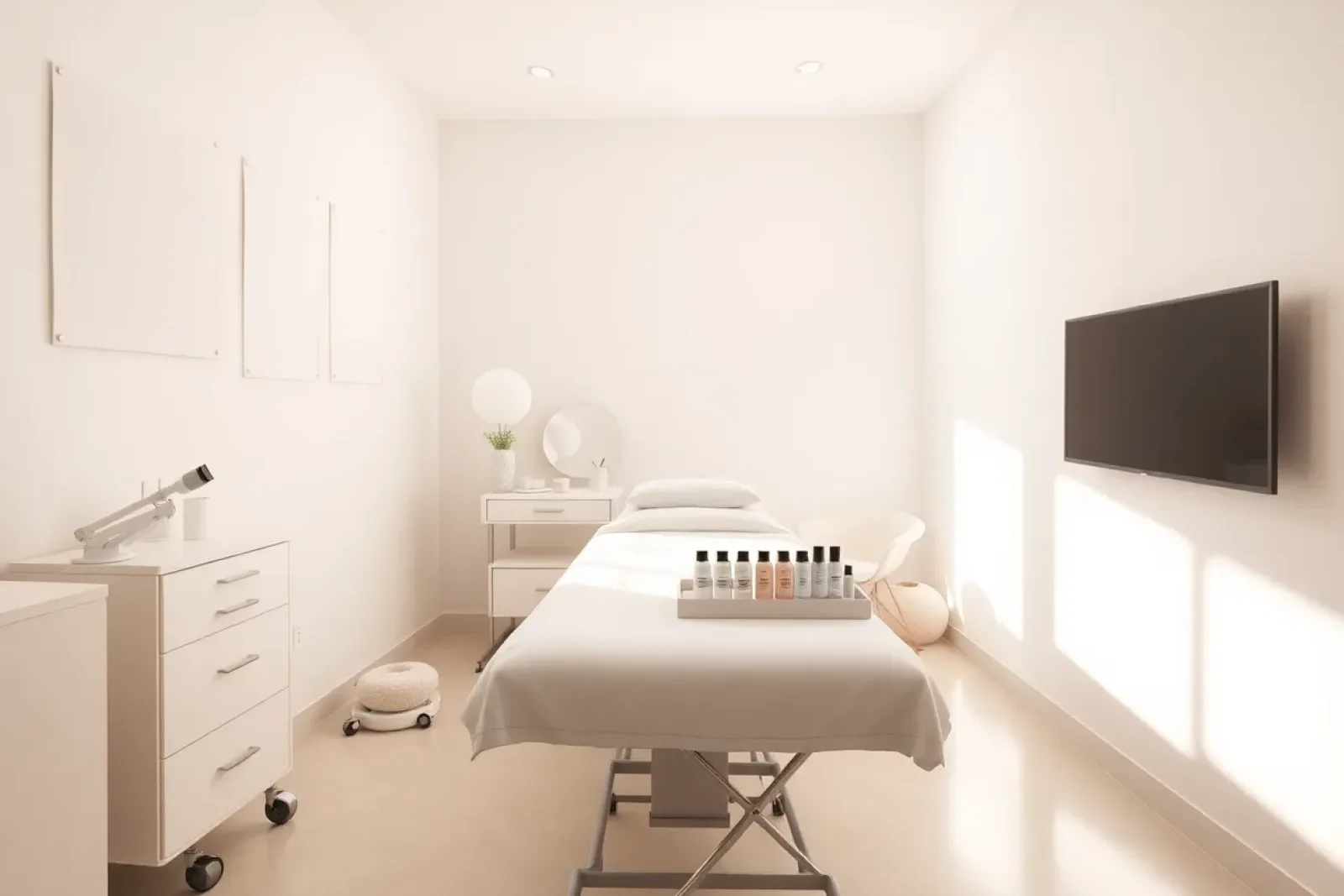
Treatment rooms need privacy, washable surfaces on every piece of furniture, a hand basin within reach and enough space to walk round the couch. Before committing to premises, list the equipment each treatment needs with its power, ventilation and storage requirements: wax heaters, steamers, magnifying lamps, a sterilisation setup if you use instruments that can break the skin, and, if you plan it, a laser or IPL device with its own safety rules and, in Wales, its own registration.
HSE's key messages for beauticians describe the main substance risks. Some ingredients in beauty and cleaning products can irritate the skin and lead to dermatitis; some, such as the liquids and powders of acrylic nail systems, can cause skin allergies and asthma; and contact with blood and tissue residues from piercing or tattooing can cause infection. The controls it lists combine good ventilation, working methods that avoid contact and spills, careful hand care, extraction for nail work and, for some tasks, gloves, aprons and eye protection. In Great Britain, health and safety where the main activity is manicuring or other cosmetic services is enforced by the local council, which makes the council your health and safety inspector as well.
The daily hygiene routine for a beauty salon: hands disinfected before and after every client, a fresh couch roll for each person, surfaces and contact points disinfected between clients, single-use spatulas and wax that never goes back into the pot once it has touched a client, and instruments that can break the skin either single-use or cleaned, disinfected and sterilised. The hygiene plan template has a beauty studio version with these rows; enter your own products, concentrations and contact times from the manufacturer's instructions.
Related articles
4. Costs and pricing: room time, consumables and courses
A beauty salon's cost structure has one feature the hair trades lack: devices whose cost has to be spread over many treatments. List one-off costs (fitting out the rooms, couches, trolleys, steamers and heaters, devices with their training, the first stock, licence and registration fees, deposits) separately from running costs (rent and rates, energy, wages, consumables, laundry, device servicing and, where required, laser safety advice, insurance, software, card fees and ongoing training).
Price by room time rather than by the name of the treatment. Work out what one hour of a treatment room costs when it is actually in use: monthly running costs divided by the room hours you realistically expect to sell. Multiply that by the treatment's duration, including preparation, any consultation and the time to reset the room, then add the consumables per treatment, from wax and couch roll to single-use tips. For device treatments, add a share of the device itself: purchase price or finance divided by the number of treatments you expect it to deliver before replacement, plus servicing. Only then add your margin.
Courses of treatment need a second calculation. A discounted course only works if the diary can hold the follow-up appointments at the intervals the treatment needs, and if you know what happens to prepaid sessions when a client stops halfway. Write down those rules before you sell the first course, and plan the intervals in the client's record rather than in your head; treatment plans and client history in a beauty studio shows how. Keep VAT in view too: a course paid before VAT registration and delivered afterwards is worth a question to your accountant.
5. First clients: visibility, booking and a record of every treatment
Set up your Business Profile on Google with your main treatment categories, opening hours and real photos of the rooms and results, and make sure it leads to one booking path. Decide which treatments clients can book directly and which need a consultation or a patch test first; a booking page of your own can show that difference with separate services and durations, as described in making a beauty studio bookable. A confirmation straight after booking and a reminder in good time protect long appointments in particular; the appointment confirmation templates can be adapted to carry patch test and preparation instructions.
The client record holds what was done, with which product and settings, the result of any patch test with its date, contraindications the client disclosed, and how the skin reacted afterwards. Much of that is data concerning health, which Article 9 of the UK GDPR places in a special category: ask for the client's explicit consent before recording it, limit who can read it, and decide how long you keep it. The client record card template has a beauty version with a consent line to start from.
If you would rather not run booking, reminders and records on paper, beauty salon software such as Salon Wizard or a comparable system brings them together; the page on software for beauty studios explains what matters.
First, write your treatment list and check, nation by nation, which lines on it need a registration, a licence or a device registration where you plan to open. Second, choose premises that can pass the inspection, register the business with HMRC or Companies House, arrange insurance that names every treatment, and check the ICO fee.
Third, price each treatment by room time, consumables and device share, write down your rules for courses, and open bookings with a consultation or patch test step for every treatment that needs one.
Structure your beauty studio?
Connect treatments, consultation, client records and online booking for your studio.