Table of contents
A nail salon can open in a small unit with a modest fit-out, which is exactly why the details get overlooked. The questions that decide whether it works are dust and vapour at the desk, whether your borough licenses manicures, and whether the price of a set covers the time, the product and the refill that follows it.
This guide walks through the steps in order: what the law expects of a nail technician, the registrations and licences, the premises and extraction, costs and pricing for sets, refills and nail art, and filling the desks with regular clients. England, Wales, Scotland and Northern Ireland are named wherever the rules differ between them.
Statements about law and safety come from legislation.gov.uk, GOV.UK, the Health and Safety Executive and the Health and Safety Executive for Northern Ireland, checked in September 2026. Where a rule could not be verified, the text names the office to ask instead of offering a guess. The guide covers the UK, not Ireland.
1. Qualifications and prerequisites for nail work
We have found no UK law that requires a nail qualification before you offer manicures, gel polish or acrylic extensions for money. Nor do the registration schemes for skin piercing list nail work: in England, the Local Government (Miscellaneous Provisions) Act 1982 covers tattooing, semi-permanent skin-colouring, cosmetic piercing, electrolysis and acupuncture, and the Welsh, Scottish and Northern Irish schemes cover similar procedures. Greater London is the exception. Outside the City of London, a borough's special treatment licence under the London Local Authorities Act 1991 covers premises used for manicure, and GOV.UK names manicures among the treatments it adds. If your salon is in a London borough, that licence comes before the opening day.
What binds every nail salon is health and safety law, because nail products are chemicals. In Great Britain, the Control of Substances Hazardous to Health Regulations 2002 (COSHH) require employers to prevent exposure or, where that is not reasonably practicable, to control it adequately, and HSE's sheet for nail bars (SR13) shows how. It names the hazards directly: acrylic liquid and powder systems can cause dermatitis and may be flammable, filing creates dust that can cause wheezing, chest tightness and asthma, and acrylic vapour can cause headaches, dizziness, nausea and irritation. HSE adds that face coverings worn against respiratory droplets do not protect against nail dust and odours and are not an acceptable control measure.
Every technician needs to know the products in use, how to read a label and a safety data sheet, and how to use extraction and gloves properly, so keep a training record for each person. If you employ staff, the ordinary employer duties apply as well: the National Minimum Wage, a workplace pension for eligible staff, a right to work check before anyone starts, and employers' liability insurance.
At a nail desk, the air nobody sees matters as much as the work everybody photographs.
2. Registration, tax, insurance and who inspects you
Tax. Register with HMRC for Self Assessment as a sole trader once you earn more than £1,000 in a tax year, or set up a limited company at Companies House before trading. VAT registration is compulsory once taxable turnover over the last 12 months goes over £90,000, and once registered you must charge VAT on the services you sell. Making Tax Digital for Income Tax is being phased in for sole traders: it applies from April 2026 where qualifying income was over £50,000 in the 2024 to 2025 tax year, then from April 2027 above £30,000 and from April 2028 above £20,000, and it brings digital records and quarterly updates on top of the annual return.
Licences and inspection. In London boroughs, apply for the special treatment licence early: GOV.UK says premises are usually inspected before a licence is granted, and London licences must be renewed at intervals that vary by borough. Elsewhere, ask the council's environmental health team whether anything applies locally. The council is also your health and safety regulator: in Great Britain, councils enforce health and safety where the main activity is manicuring or other cosmetic services, and in Northern Ireland HSENI lists nail bars among the premises that fall to the district council.
Fire, insurance and data. Because acrylic systems may be flammable, take the fire risk assessment seriously: in England and Wales, the person in control of business premises must carry one out and review it regularly, while Scotland and Northern Ireland have their own fire safety rules. Employers' liability insurance with at least £5 million of cover is compulsory as soon as you employ someone, in Great Britain under the 1969 Act and in Northern Ireland under a 1972 Order, and the certificate has to be displayed where staff can see it. Client records mean personal data, so check the ICO's self-assessment for the data protection fee.
3. Premises, extraction and the nail desk
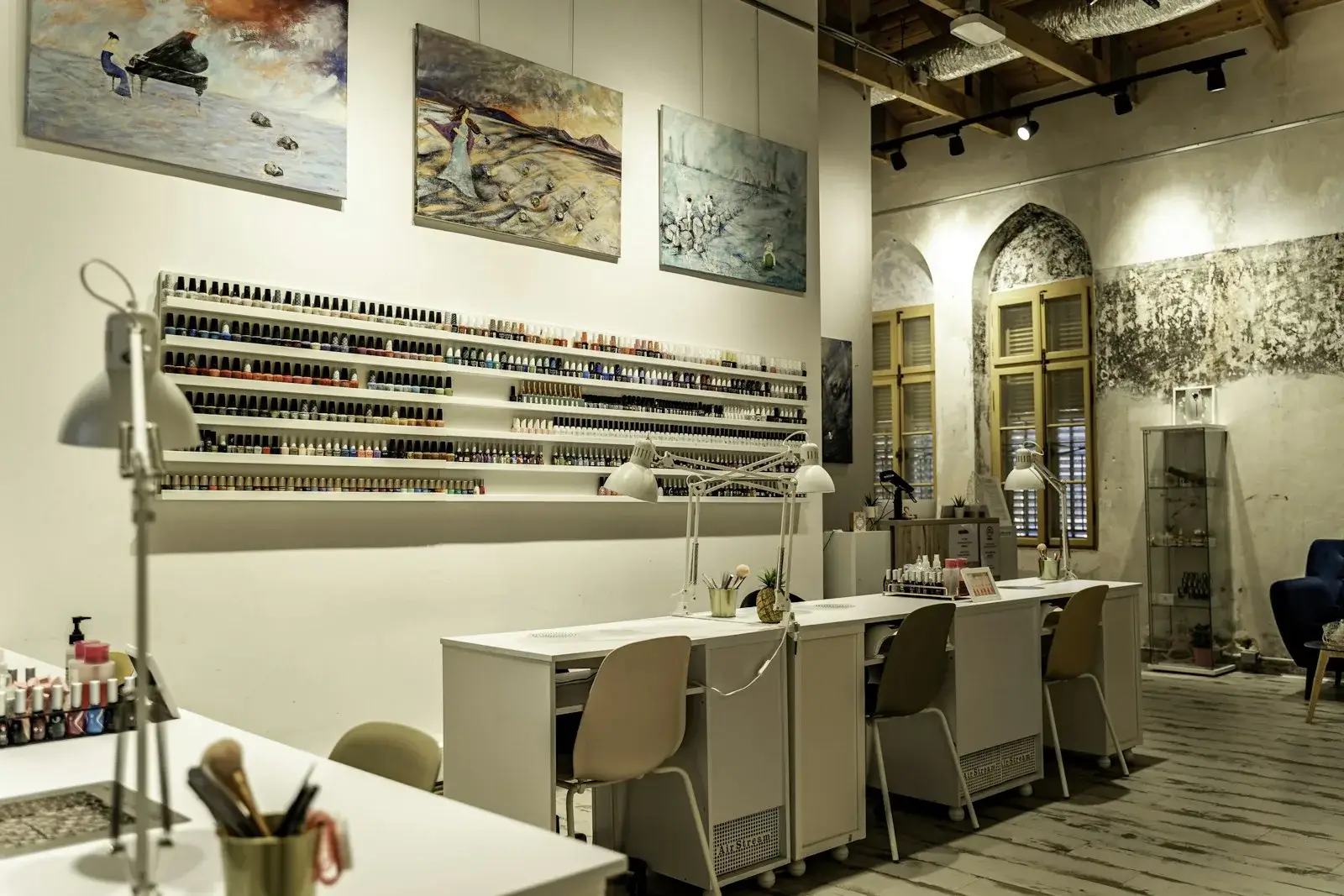
Extraction is the decision that shapes a nail salon's premises. HSE's SR13 asks for local exhaust ventilation (LEV) at the desk, as a downdraught table or a movable hood, with the nails held over the downdraught or as close to the hood as possible, plus a good standard of general ventilation, for example powered wall or window fans. The extracted air has to be discharged to a safe place outside the building, away from doors, windows and air inlets, or correctly filtered before it returns. Find out from the landlord where ducting can run before you sign anything.
LEV is not a one-off purchase. HSE says LEV systems require a statutory thorough examination and test by a competent person at least once every 14 months, that you should carry out the actions arising from it, and that the records should be kept for at least five years; check the equipment for signs of damage before starting work. Put the first test date in the diary on the day the system is installed.
The rest of SR13 reads like a desk checklist: buy products ready to use where possible, put caps back on straight after use, store products in a cool, dry, dark and ventilated place in a way that retains spills, keep only the amount you need, and put materials contaminated with nail products and solvent in a lined, lidded bin. Provide single-use nitrile gloves and eye protection for topping up bottles, and eye protection when filing. Between clients, files and buffers that cannot be disinfected are used once or handed to the client, e-file bits are cleaned and disinfected after every client, and the extraction filter is changed as the manufacturer specifies; the hygiene plan template has a nail studio version with these rows ready to adapt.
Related articles
4. Costs and pricing: sets, refills and art
List the one-off costs first: desks with extraction, ducting and its installation, chairs, lamps, e-files, a disinfection setup, the rest of the fit-out, the first stock of each system you offer, and any licence fee. Running costs cover rent and rates, energy, wages, products and consumables, e-file bits and filters, the regular LEV examination, laundry, waste collection, insurance, software and card fees.
For the price, begin with time, because that is where nail margins disappear. Measure how long each service really takes: a new set, a refill, a removal, a repair, a gel polish manicure, and nail art at a few levels of detail. Then work out what a desk hour costs while a client is sitting at it, by dividing the monthly running costs by the desk hours you expect to sell. The price floor of a service is its measured duration multiplied by that hourly cost, plus the material it uses; to find the material cost, count or weigh what a typical set actually consumes over a week rather than working from the price of the pot.
Removals and repairs deserve their own lines on the price list. If soaking off another salon's work is hidden inside a new set, the set is underpriced for every client who needs it. The same applies to nail art: prices tiered by complexity, rather than one flat surcharge, let clients book an appointment of the right length. A worked method for pricing material, time and art is set out in nail studio pricing. Finally, price the refill to cover its own time rather than discounting it into a loss, because regular refill clients are what fills the diary.
5. First clients: the diary, reminders and a record of every set
Describe your services in your Business Profile on Google in the words clients use when they search, add accurate opening hours and post photos of your own sets. On your booking page, keep the new set, the refill, the removal and each art tier as separate services with realistic durations, so that a client cannot book a refill slot for a full new set; how to name and time them is covered in planning refills, new sets and nail art.
Reminders matter especially for refills, which are often booked weeks ahead. Confirm each booking immediately and remind the client in good time with an easy way to move the appointment, because a refill that is moved can still be filled while a missed one cannot; the confirmation and reminder templates give you wording for email and text. Promotional messages are a separate matter: under the ICO's rules on electronic marketing you need consent or, for your own clients, a clear chance to opt out when you collect their details and in every message.
Keep a short record for every client: nail shape and length, the system and colour used, the product batch if you track it, and any reaction such as redness around the nail. A reaction is data concerning health under Article 9 of the UK GDPR, so record it only with the client's explicit consent and keep it away from general view. The client record card template has a nail studio version to print. If you prefer the record, the booking page and reminders in one place, nail salon software such as Salon Wizard or an equivalent system can do that; the page on software for nail salons explains what to compare.
First, check whether your borough requires a special treatment licence and register the business with HMRC or Companies House. Second, plan extraction before anything else in the fit-out, following HSE's SR13, and diary the first thorough examination of the LEV the day it is installed; add the fire risk assessment and employers' liability insurance before your first employee starts.
Third, time every service honestly, price each one from the cost of a desk hour plus material, list removals, repairs and art separately, and open the booking page with separate services for sets and refills.
Plan nail appointments better?
Manage refills, nail services, buffer times and client history in one place.