Table of contents
Most nail studios are run by one person who treats, advises, answers and invoices all at once. Software has one job above all: to relieve that person, not to occupy them.
The shortlist usually holds the same names: Booksy, Fresha and Treatwell as booking platforms, alongside Timely, Salonized, Mangomint and Square as business systems. What stands out is that many of them were designed for businesses with a reception desk and a team. A nail studio often has neither — the owner is sitting at the table, and every query interrupts work in progress.
This article therefore looks at the choice from the small business's side: what changes in a one-person day, how much administration a system really takes away rather than merely moving, what role pictures play, how to stay reachable without living in a chat all day, and what tells you after a few weeks whether the choice has held.
1. A business without a reception desk asks different things of software
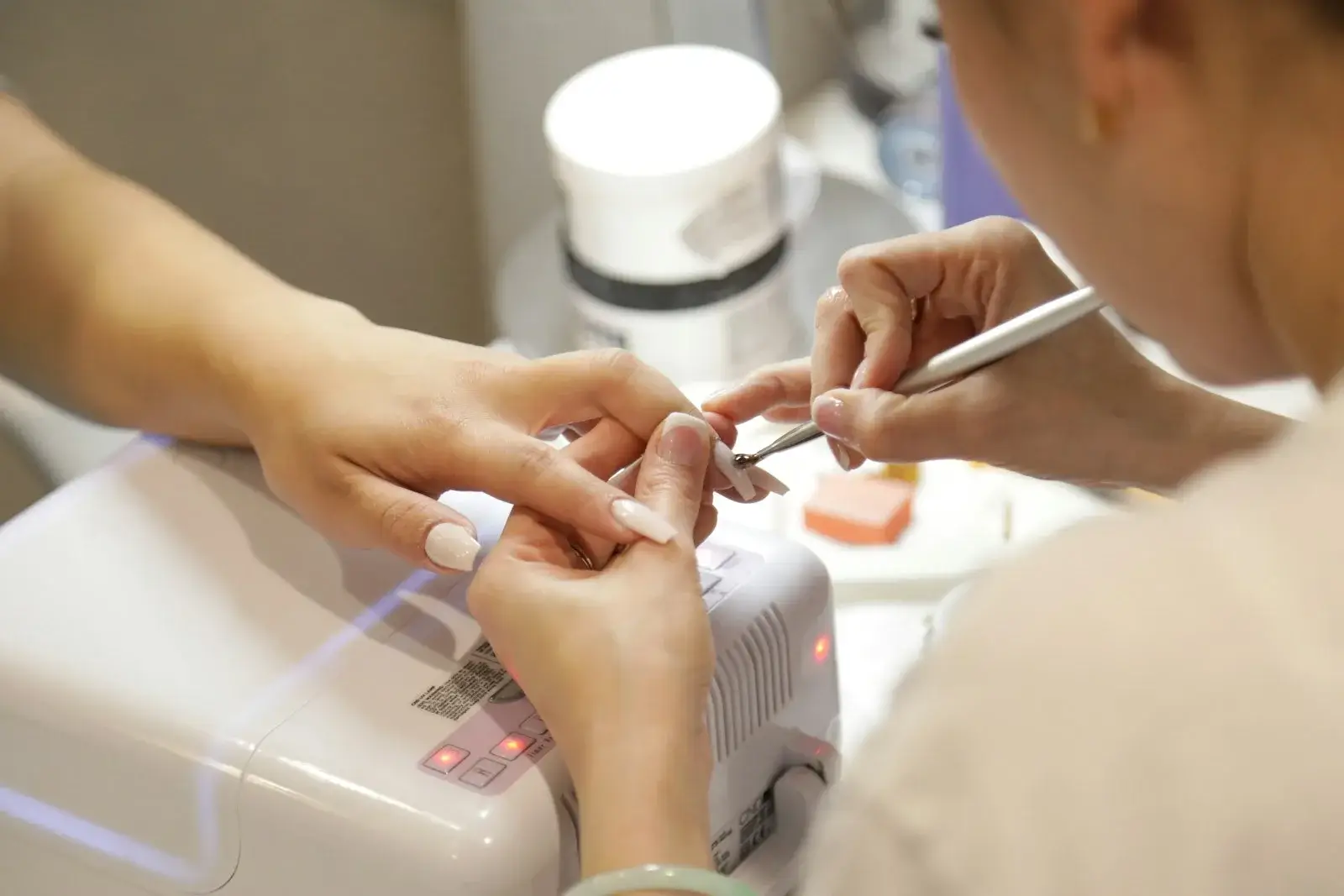
In a nail studio every enquiry interrupts work in progress. Somebody building up an extension cannot pick up the phone, and whoever answers is not working while they do. The real job of software here is therefore not to manage appointments but to avoid interruptions.
From that follows a clear order of assessment. First: can clients book themselves without a query — at any hour, without an account and without a call? Second: do the confirmation and the reminder go out on their own? Third: can changes also run without you, as long as they stay inside your rules? Everything else is secondary.
Just as important is where the system is operated. One that only makes sense at a desktop computer helps little in a one-person business; nobody stands up there to type something in. Whatever cannot be done at the table on a phone in a couple of taps gets caught up in the evening — or not at all.
Anyone sitting at the table cannot be on the phone at the same time. That is not an organisational weakness, it is the starting position.
2. Does the system take administration away or just move it?
The most common moment of disappointment after a rollout is realising that the effort has not vanished, only changed place. Instead of answering messages you now maintain master data; instead of entering an appointment you check bookings. For a one-person business that is no progress.
So test on concrete operations where the work lands. How many taps does it take to arrange a follow-up appointment while the client is still at the table? How many to process a cancellation and offer the slot again? And what happens when you have to close for a day at short notice — do you then write to every client individually?
A good indicator is the number of things you keep in duplicate. If a paper diary, a notes app and a chat history still exist alongside the system, the system has not taken over the administration, it has only joined it. The aim is that one place remains at the end, not four.
3. In a nail studio, pictures are working equipment
Hardly any other trade works so heavily with pictures. They are advertising, memory and a means of understanding at once: a design is agreed through a photo, found again through a photo and passed on through a photo. A system that knows pictures only as a gallery on the website covers the smaller part of that.
Three requirements follow. First, pictures have to be tied to a client so they are there at the next appointment without searching. Second, the public display has to exist separately — what gets shown is a deliberate selection with consent, not a side effect. Third, your own page should show the work at a quality that can actually be judged, because that is exactly what decides in favour of a studio.
Going by way of social channels is no substitute. A stream of posts is sorted chronologically, not by service; anyone looking for one particular piece of work has to scroll. And access to that collection does not belong to the studio — one more reason to treat your own address as the main location and the channels as feeders.
Related articles
4. Being reachable without living in a chat all day
Many nail studios handle their appointments through direct messages. It works at the beginning and turns into a time sink as the clientele grows: every enquiry takes several messages, they arrive at all hours, and none of them land where the appointments are.
The way out is not to become unreachable but to reverse the direction. Once the most frequent questions are answered on your own page — what a service covers, how long it takes, what it costs, when something is still free — only the unusual is left for a message. And the unusual is exactly what deserves a personal answer.
A visible frame helps too: a note saying when messages get answered. Stating that enquiries are dealt with on certain days at certain times does not read as unreliable, it reads as organised — and it means not reaching for the phone between two clients.
5. What tells you after four weeks whether it fits
The decision for a system cannot be judged by its feature list, only by the changed working day. So plan before the rollout to look at three things after roughly four weeks, and note the starting figures beforehand.
First: how many appointments came about without your involvement? If that share does not rise, the system is not working where it should. Second: how many messages did you have to answer to arrange one appointment? If nothing has changed there, the old route is still the main route — usually because it is still being offered somewhere. Third: how many follow-up appointments are already fixed? That is the figure that decides the coming months.
Salon Wizard aims at exactly those three points: a page of your own with gallery and direct booking, a client record with history and pictures, automatic reminders and follow-up appointments. Not included are till management, payment processing and stock control. Whether your business needs something separate for those is another question — on till management your tax adviser will advise you more reliably than any software comparison.
For a nail studio the right software is the one that interrupts the business least. Make sure clients can book without a query, that the system can be worked at the table on a phone, that pictures belong to the client rather than only to a gallery, and that one place remains at the end instead of four — then measure again after four weeks.
Plan nail appointments better?
Manage refills, nail services, buffer times and client history in one place.