Table of contents
Which fields a client record actually needs, when it gets read at all, and how a team writes into it so that everyone else can understand what is there.
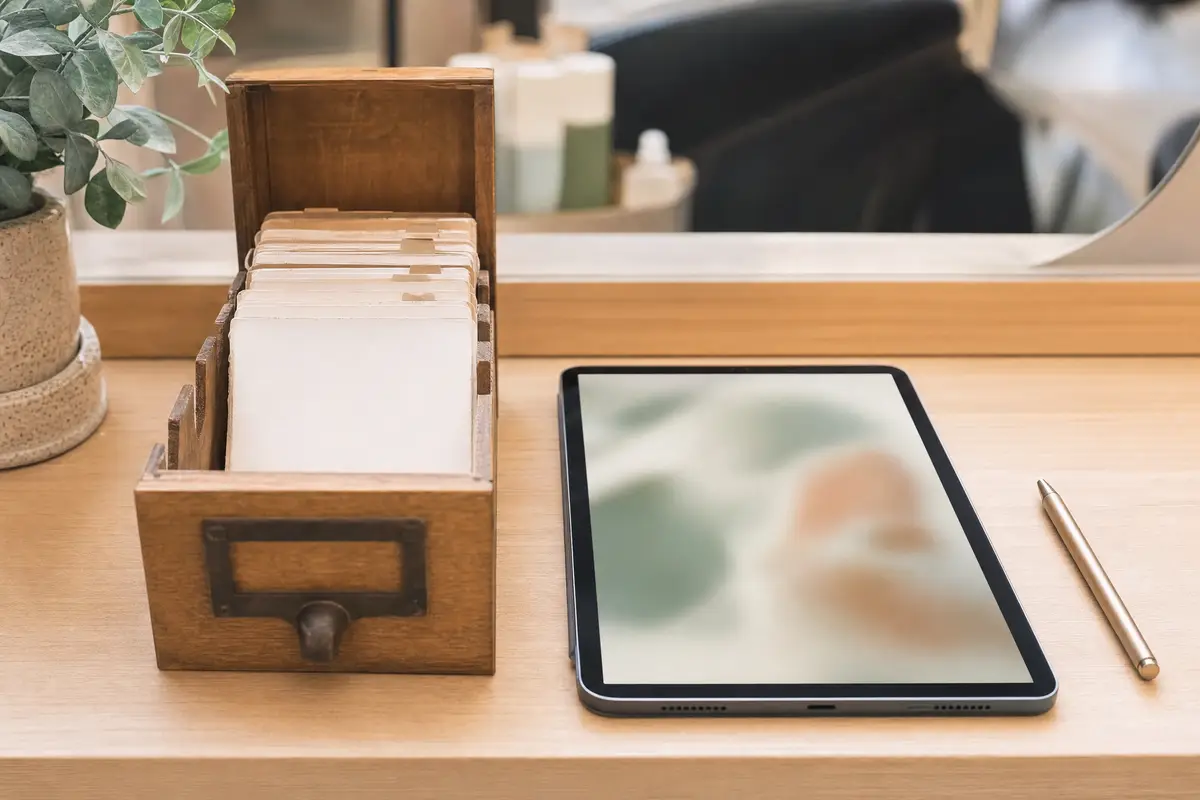
Almost every studio already keeps client records. They simply sit in four places at once: a few cards in a cupboard, notes in the appointment book, messages on the manager's phone, and the rest in the memory of whoever served that client last. As long as the same person always looks after the same client, this works surprisingly well. It breaks the moment somebody falls ill, leaves or goes on holiday.
This article therefore does not describe which software has a client record, because almost all of them do. It describes what belongs in a record and what does not, when it actually gets read in the working day, how a team manages to write into it intelligibly, and which questions about access and retention you should settle beforehand. Salon Wizard carries such a record together with appointments and booking; the rules in this article apply regardless of that.
1. What is scattered today across paper, chat and memory
Before you set anything up, a stocktake pays off. Walk through the studio once and note every place where information about clients is held. In most businesses that produces five to eight places, and half of them are known to one person only.
The usual ones: the record cards or notebook at reception, marginal notes in the paper appointment book, message threads on several phones, a spreadsheet for vouchers or treatment courses, consent or intake forms in a folder, and the knowledge in someone's head, meaning the allergy, the appointment that always gets moved, the name of the dog.
That list is worth more than any provider's feature overview, because it tells you two things. First, which information your business actually needs, as opposed to what a system offers. Second, where your risk sits: every place known to one person only is a gap that shows itself on the day that person is away. Those places are the first that belong in a shared record, and not the fields that look best in the demo video.
A record nobody looks into is an archive. Notes only become work once they are read.
2. Which fields a record carries and which are just ballast
A record does not get better by having more fields. It gets worse, because every additional field has to be maintained, and an empty field quickly becomes a field nobody trusts any more.
A workable core is modest: name and contact details, the last few appointments with the service delivered each time, the technical details of your own trade (formula, colour, needle gauge, product line, skin reaction), notes on tolerance, preferences about how the appointment runs, and a note when something did not go smoothly last time. Plus the usual rhythm, every four, six or eight weeks, because the next appointment follows from it. What those trade-specific fields look like in practice is illustrated by software for a nail studio.
You recognise ballast by a single question: will this field ever change a decision? A birthday is a field if you genuinely do something with it, and ballast if you do not. Free-text boxes for anything and everything are almost always ballast, because what goes into them cannot be found again. Better to start with too few fields and add the one you have missed twice in daily work. That route leads to a record that gets used.
3. The first two minutes: when a record actually gets read
The moment when client records pay off is short and always the same: the client is already seated, the coat is hung up, and you have roughly two minutes before the work begins. Whatever cannot be found in that time does not exist in daily practice.
Three sober requirements follow. The record has to be reachable on the device that is already in your hand, usually a phone rather than the computer in the back room. The path from the appointment to the client history has to be one step, not three. And the important part has to be at the top: tolerance and last service before everything else, with no scrolling.
Test this on a candidate system literally like that. Open the calendar on the phone, tap the next appointment and count the steps until the note from the last visit is readable. Do it with the device your team really uses, and in the lighting you actually have at the workstation. A system that does not serve those two minutes will not replace the record. It will turn it into a sixth place where information sits.
Related articles
4. One team, one way of writing: notes everyone understands
As soon as more than one person writes, a second problem appears that no software solves: notes are written for the writer's own memory and not for anyone else's eyes. The remark that is unambiguous as you write it is a riddle to the team three weeks later.
It helps to agree a few shared rules and write them down once. Four are usually enough:
- always record the outcome, not just the intention: what was actually done, with which product and in what quantity;
- abbreviations only from a shared list, everything else written out;
- keep observations separate from judgements: how a skin reacted belongs in the record, what a person was like does not;
- write the note straight after the appointment, not in the evening, because by then half of it has gone.
These rules cost half an hour of a team meeting and decide whether the record is still readable a year later. Take ten minutes once a quarter as well and read five entries at random from across the team. Whatever you cannot understand is the point the next meeting has to settle.

5. Access, retention and handling sensitive details
A client record contains personal data, and part of it is particularly delicate: details about skin condition, tolerances, medication or pregnancy are health data, not preferences. That does not change the fact that you need them, but it does change how carefully you should handle them.
Three organisational questions should be answered before the first note is written. Who on the team sees which entries, and can the system distinguish that at all? How long do details stay in place, and is there a point at which they are removed? And what happens when a client asks what is stored about them, or asks for something to be deleted: who handles that, and how quickly?
Settle as well where the data sits and who processes it on your behalf. Asking a provider for processing within the EU or EEA and for a written processing agreement is entirely normal and should be answered without evasion; the wider picture is set out under GDPR-compliant software. What this article deliberately does not contain is a legal assessment of your particular case, which requires a look at your own processes and, in case of doubt, belongs with a data protection adviser. What you can do without outside help is the obvious: collect no more than you need, leave nothing sitting in message threads, and agree in the team who may see what.
Digital client records for salons and studios are not an archive but a working tool for two minutes per appointment. They become good when they carry few fields that are genuinely used, are reachable in one step, are written to shared rules, and have clear boundaries on access. Everything else, meaning longer field lists, prettier views, more reporting, is only interesting after that.
Card box or digital records?
Addresses, treatments and history in one place, readable for you and your team - on servers in Germany.