Table of contents
Digital client records for hairdressers: what the record has to hold, how it earns its keep at the chair, and how you get the data out of a system again.
Most searches for client records or salon client management do not come from an abstract wish for a CRM. They come from colour formulas, client notes, preferences, the allergy note taken during a consultation, appointment history and regular-client care — and from the wish that none of it disappears into chat threads and paper cards.
Salon Wizard hairdressing software ties the client record to online booking, the team, the services and the salon's own website. That keeps the client history from sitting in isolation and makes it available where appointments are planned and client relationships are actually maintained.
1. What a hairdressing client record actually has to hold
A digital client record for a hair salon should carry considerably more than a name, a phone number and a last appointment. What matters is the working detail: colour formulas and mixing ratios, developer strengths and processing times, preferences and dislikes, sensitive notes taken during the consultation, the thread of what was discussed, the no-show history, and the question of who on the team served this person last.
Two categories are worth separating deliberately. The first is what the salon needs in order to repeat a result: everything about the technical work. The second is what the salon needs in order to have a conversation: the holiday that is coming up, the wedding the growing-out is timed for, the fringe that was regretted last spring. Systems tend to be built for the first category and leave the second in a free-text box — which is where it belongs, provided the box is actually visible at the chair.
What should not be there is anything nobody uses. A field that gets filled in because it exists, and read by no one, is pure liability: it has to be maintained, disclosed on request and deleted on schedule, and it buys the salon nothing at all.
A client record earns nothing by being complete. It earns its keep by being readable while the client is already in the chair.
2. Speed at the chair: finding the last visit in seconds
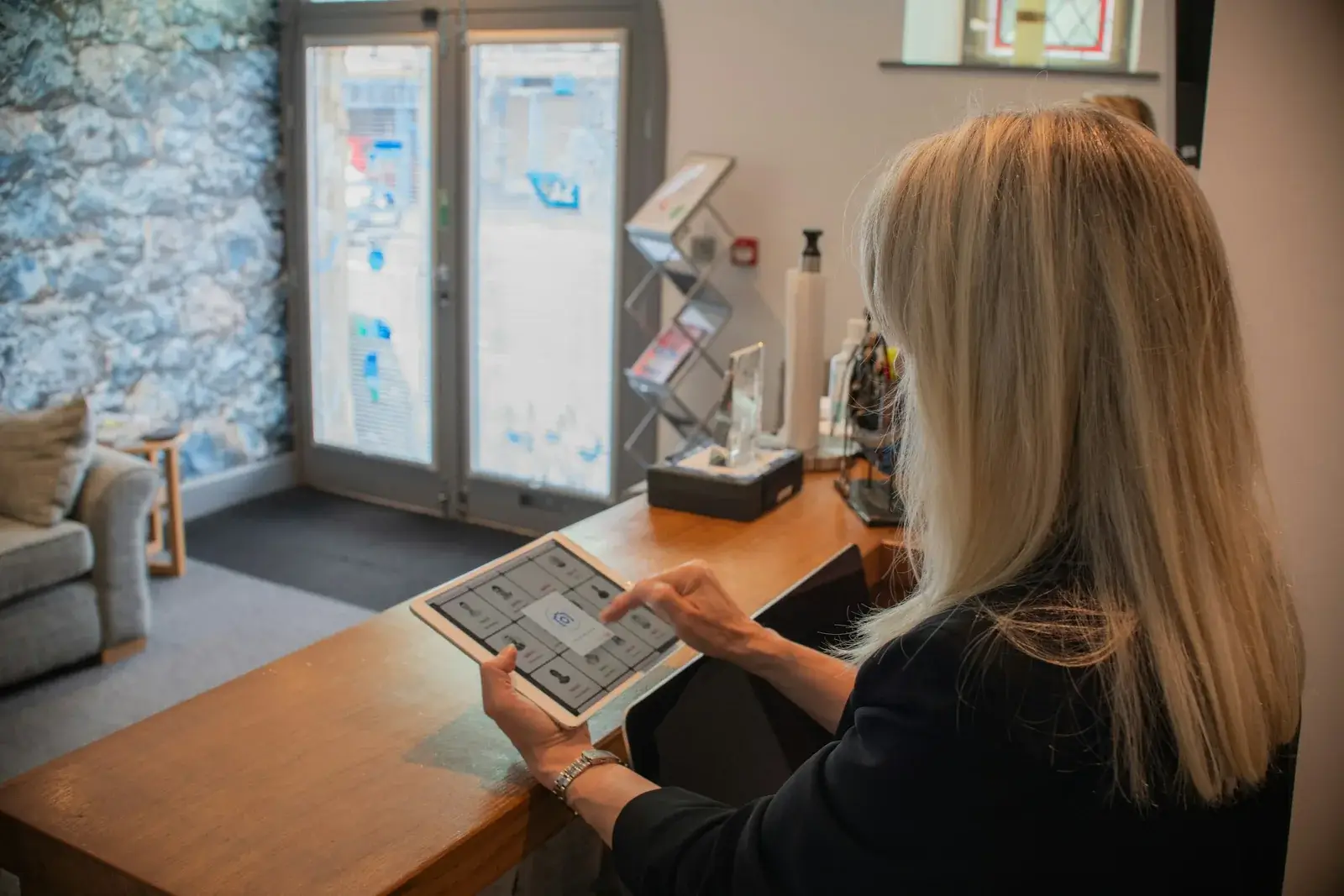
For regulars, speed is the whole point. At the next appointment the team has to see quickly what was discussed, which colour worked and whether there is anything to note for the consultation or the service. That is where the operational value of a client record is generated, and it is the reason paper cards survived so long: a card is found in four seconds.
So test a candidate system on exactly that motion. With a client already sitting down, how many steps does it take to reach the last colour formula? Does the search work on a partial name, on a phone number, on a misspelling? Is the record readable on a phone held in one hand, or does it assume a desktop screen at a reception counter that this salon does not have?
The second half of speed is writing, not reading. If a note can only be added by opening a separate screen after the appointment is closed, it will not be added — it will be remembered until the end of the day and then lost. A record that can be written into during the appointment is a record that stays true.
3. From the record to the next appointment
Client data is only worth keeping when it comes together with services, duration, team availability and rebooking. A general-purpose CRM can hold everything a salon knows and still be useless, because the knowledge sits one screen away from the calendar.
The test is the rebooking motion at the end of a visit. The record should be able to say when this client is due again — a root touch-up at their usual interval, a cut at the rhythm they have actually kept, not the rhythm the salon wishes they kept. Offering that next appointment at the chair, from inside the record, converts far better than hoping the client books later from home.
The same data supports the quieter side of retention: seeing who has not been in for noticeably longer than their own interval, and knowing why before making contact. Where that turns into a structured programme is a subject of its own — see loyalty programmes for hair salons.
Related articles
4. Export, portability and getting the data out again
Client records are the asset a salon builds over years, and they are the reason a system change is hard. So the export question belongs in the selection, not in the exit interview: not every piece of software has to solve every special case the same way, but the salon should know before deciding how it would evaluate, back up or extract its client data if it needed to.
Three questions cover most of it. Can the whole client base be exported in a readable format, complete with notes and appointment history rather than names and phone numbers alone? Can a single record be exported on its own, which is what an individual client request calls for? And does the export still work after notice has been given — the answers to that differ noticeably between providers.
Keep this separate from the till. Payment records, receipts and takings live under their own rules and often in their own system; the client record is not the place to reproduce them. Where that line runs is covered in salon software without a POS.
5. A checklist for hair salons
- Formulas: can formulas, preferences and notes be found again in seconds, on a phone?
- History: are appointments, services and the responsible team member traceable?
- Writing: can a note be added during the appointment rather than afterwards?
- Rebooking: does the record support the follow-up appointment and regular-client care?
- Privacy: is there clear information about processing, access rights and the processor contract?
- Export: can the client base and a single record both be taken out in a readable format?
- Separation: is client management clearly divided from booking and from the till?
A lean setup fits particularly well when a salon wants to bring client records, online booking, team planning and its own website together without putting a heavy point-of-sale system at the centre of the business.
A digital client record pays off when it does more than store data — when it supports rebooking, the consultation and direct online appointments. Judge a system on the two motions that happen every day rather than on the length of its field list: how fast the last visit is found while the client is already sitting down, and how easily the next appointment is made before they stand up. For salons with their own website and a real client relationship, that connection is the most important lever there is.
Card box or digital records?
Addresses, treatments and history in one place, readable for you and your team - on servers in Germany.