Table of contents
Tattoo prices are quoted in three ways, by the hour, by the piece or by the day, and artists argue about which is fairest. The choice matters less than it seems, because all three should come out of the same calculation: what an hour at the needle has to earn once drawing, set-up and the hours nobody pays for are counted.
This guide builds that calculation step by step. It separates needle hours from working hours, prices the sterile single-use kit that every session opens, compares the three ways of quoting, and treats deposits and drawing time as part of the price rather than something beside it. It ends with written quotes, rounding, VAT and raising your rate without breaking the quotes you have already given. The registrations and licences a studio needs first are covered in how to open a tattoo studio.
Legal points were checked on 25 September 2026 at legislation.gov.uk, GOV.UK, nidirect and in guidance from the Competition and Markets Authority. Example amounts are round numbers for illustration only, not studio prices.
1. Needle hours are fewer than working hours
The hours an artist spends tattooing are only part of the hours they work. The rest goes on consultations, drawing and redrawing, messages about ideas, placement and aftercare, preparing stencils, setting up and breaking down the station, cleaning, ordering supplies, social media and the admin of a small business. All of that is work, and all of it has to be paid for by the hours in which the machine is running.
So begin with needle hours per year. Take the weeks you actually tattoo, after holidays, conventions, guest spots elsewhere and illness. Employed artists have a legal minimum of 5.6 weeks' paid holiday a year, as GOV.UK and nidirect both state, while self-employed artists simply earn nothing in the weeks they are away. Multiply the weeks by the sessions you do in each and by the hours actually tattooed per session, which is less than the length of the booking once breaks and stencil changes are taken out. Check the result against last year's diary if you have one.
In a studio that draws custom work, drawing is often the largest unpaid block. Track it for a month: how many hours went into designs, how many of those designs were tattooed, and how many were dropped because the client changed their mind. That figure decides whether drawing is carried by the hourly rate, by the deposit or by a separate design fee.
The needle hour pays for the drawing, the set-up and every hour that nobody books.
2. The fixed cost of every session
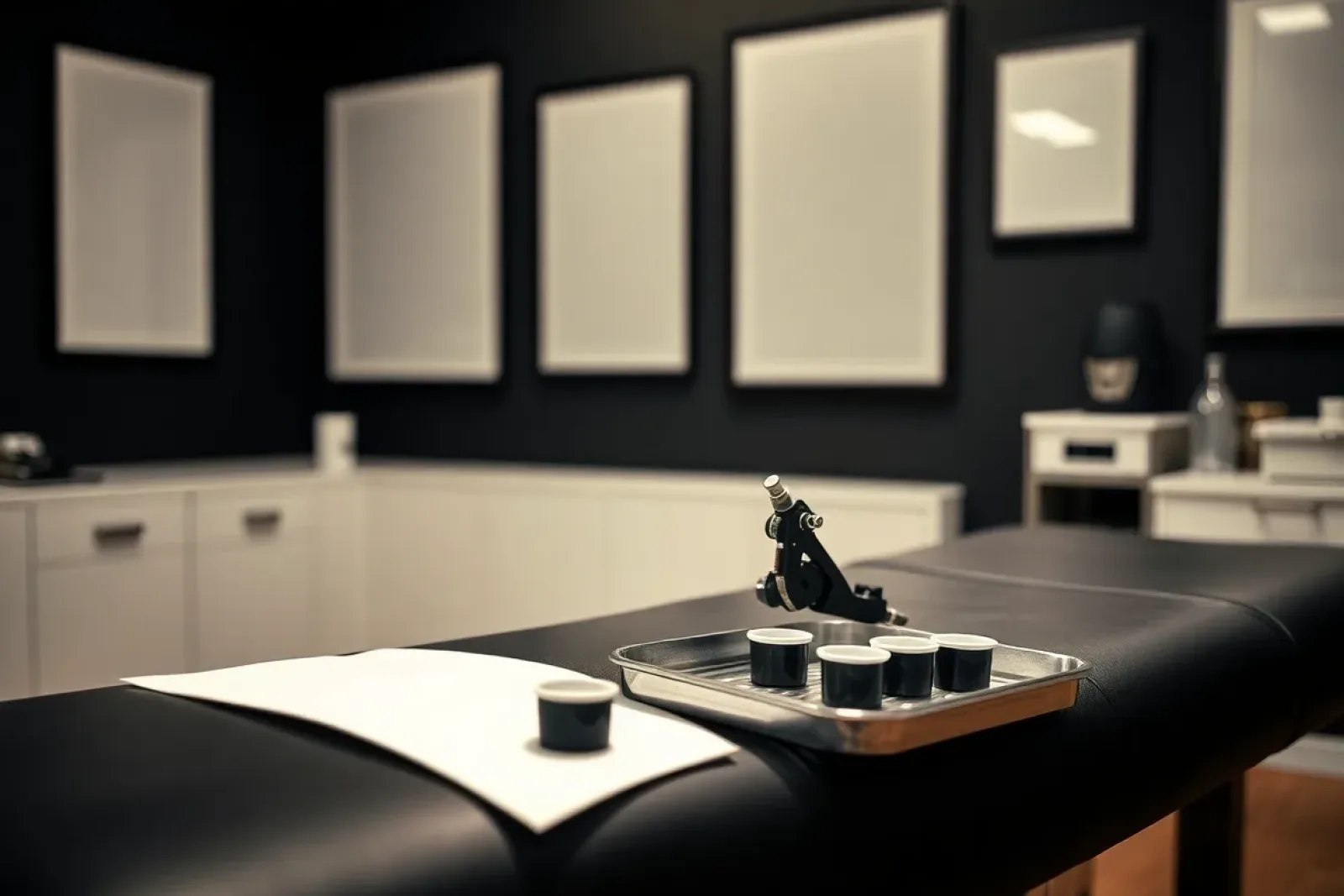
Every session opens a sterile, single-use set whatever its length: needle cartridges or needles, ink caps, barrier film and bags for the machine, clip cord or cable covers, several pairs of gloves, a couch cover, stencil paper, skin preparation, ointment and dressing, paper towels. Add the inks used, a share of the sharps container and the clinical waste collection, and the laundry. Count this set properly once and you have a cost per session that does not depend on the size of the tattoo.
- Needle-hour rate = (studio costs + your income target + reserve) ÷ needle hours per year
- Session price = set-up cost + needle-hour rate × hours tattooed + drawing time, if not charged separately
- Minimum charge = set-up cost + the shortest time you would book, at the needle-hour rate
An example calculation with round numbers, not studio prices: yearly costs and an income target totalling £60,000, spread over 750 needle hours, give a rate of £80. A small piece that takes forty minutes, plus a set-up cost of £20, then comes to about £73, well below a minimum charge built on a full hour. That gap is exactly what a minimum charge is for. To replace these assumptions with your own figures, use the salon price calculator.
The minimum charge is not a penalty for small tattoos. It reflects that a session costs the same to set up whether it lasts twenty minutes or five hours, and that a small tattoo still blocks a slot that is often hard to fill around it.
3. By the hour, by the piece or by the day
Hourly pricing is the most transparent to calculate and the hardest for a client to budget, because the final amount depends on skin, placement, breaks and pace. It suits large or open-ended work over several sessions. Tell the client the rate, what counts as tattooing time, for example whether set-up and breaks are included, and an honest estimate of the hours.
Per-piece pricing gives the client certainty and moves the risk to you: if the piece takes twice as long, you absorb it. It works for flash, for small and medium pieces you do often, and for artists who estimate well. Build the quote from the hourly calculation and a realistic time, not from a feeling for what the design is worth.
Day rates suit long sessions on large pieces. Derive them from the hours you can really tattoo in a day, not from the length of the booking, and say what the day includes.
Whichever you use, UK consumer law expects the client to see the total price or how it will be worked out. Before an on-premises contract, Schedule 1 of the Consumer Contracts (Information, Cancellation and Additional Charges) Regulations 2013 asks for the total price inclusive of taxes or, where the nature of the service means the price cannot reasonably be calculated in advance, "the manner in which the price is to be calculated"; Schedule 2 says the same for contracts made at a distance, such as an online booking. The CMA's price transparency guidance (CMA209) gives an hourly rate as one way to let consumers calculate a price, and it notes that a bespoke product can make a fixed total impossible. That is the case for a written quote after the consultation: it turns an open hourly rate into a figure the client has seen before the first line.
Related articles
4. Drawing time and deposits in the price
A deposit is best treated as part of the price paid early, not as an extra charge. It can do two jobs: pay for drawing that happens before the session, and reserve a date nobody else can have. Decide which of the two it is for, and whether it counts towards the final price, before you set the amount. Typical arrangements are a deposit deducted from the last session, a deposit kept against the drawing with the session charged in full, or a deposit that carries over while a large piece is in progress.
The CMA's guidance on unfair contract terms (CMA37, July 2026) is specific about deposits. It says "a genuine deposit may legitimately be kept in full" if it works as a binding reservation and the trader makes clear at the earliest opportunity that it is required and exactly when it would be non-refundable, and it adds that such a deposit "will not normally be more than a small percentage of the price". A larger prepayment, the guidance continues, "is more likely to be unfair as it may amount to a disguised penalty". Where a deposit also pays for drawing, say so, because work already done is a cost you can point to. And where the booking and the deposit are made online or by phone, the 2013 Regulations give consumers a right to cancel a distance contract within the cancellation period without giving any reason, subject to exceptions; have your terms reviewed with that in mind, and read no-show and cancellation fees in the UK for how deposits and online bookings interact.
Booking software does not necessarily handle money. Salon Wizard, for example, books consultations and sessions and sends confirmations and reminders, but it collects no payments, so a deposit is taken through your own card reader or by bank transfer and recorded in your own books. The organisational side, from wording the rules to refilling a cancelled day, is covered in tattoo deposits and cancellation rules.
5. Written quotes, rounding and raising your rate
Put every quote in writing, naming the design, size and placement it refers to, the hours or sessions you expect, and what happens if the work takes longer. Section 50 of the Consumer Rights Act 2015 treats what you tell a client about the service before the contract as one of its terms, and a change to it is not effective unless the client expressly agrees. A written quote therefore protects both sides: the client knows the figure, and you know exactly what it covered when the placement grows by a hand's width.
Round hourly and day rates to clean amounts, and quote pieces in whole pounds, rounded up to a step you use consistently. If you are VAT-registered, which is compulsory once taxable turnover over the last 12 months passes £90,000 or is expected to pass it within the next 30 days, every figure you give clients includes VAT. At the standard rate of 20% that is a sixth of the price, and a rate that felt comfortable before registration may not be afterwards.
Raise your rate for new bookings, not for work in progress: a sleeve quoted at the old rate should be finished at it, unless the change is agreed openly with the client. Useful signals for a review are a waiting list that keeps growing, rising supply costs, a move to larger premises, and the yearly recount of your needle hours. Announce the new rate on your booking page and your social channels a few weeks before it applies, and say plainly that sessions already booked keep their price.
Every tattoo price, hourly, per piece or by the day, rests on one figure: what a needle hour has to earn once drawing, consultations, set-up and unbooked time are paid for. Count your real needle hours, price the sterile set-up of each session separately, and let the minimum charge cover it for small work.
Give clients the rate or a written quote before the first line, treat deposits as part of the price with terms that are clear, narrow and proportionate, include VAT once you are registered, and change your rate only for work that has not yet been quoted.
Coordinate tattoo bookings?
Coordinate consultations, longer slots, artist profiles, gallery and client data.